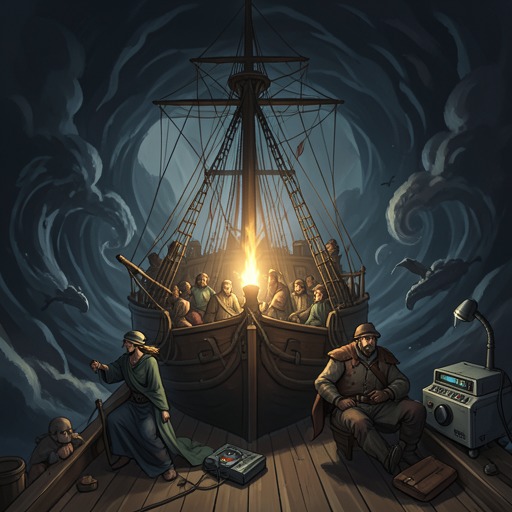
The Empress’s Expedition to Aid Her Native Country
The Blazing WorldThe Empress’s Expedition to Aid Her Native Country is a military intervention in which rescue becomes conquest. When the Empress learns that many nations are making war against her homeland, she uses the resources and sovereignty of the Blazing-World to come to its aid. The Duchess of Newcastle helps devise the passage and strategy; Fire-stone and the subjects’ specialized abilities defeat the besieging fleets. But the operation does not end with relief: the Empress makes the King of Esfi dominant over the maritime nations and presses further resistance toward submission. The expedition’s defining contrast is between its language of loyalty and protection and the coercive order it establishes.
The Threat and the Plan
The crisis begins after the Immaterial Spirits tell the Empress that her native country is at war and may be destroyed by numerous enemies. Her grief is so evident that the Emperor notices her tears and asks what troubles her. He offers the Blazing-World’s assistance, but the Empress doubts that help can be carried across worlds. The Immaterial Spirits cannot fight with artificial weapons, and using human bodies as their vehicles would not supply a workable army: the bodies would be difficult to gather and preserve, and their own souls would resist being governed by the spirits. The problem is therefore practical as well as political: the Empress must find a material route and a force capable of acting there.
The Emperor recommends that she seek the counsel of her Platonic friend, the Duchess of Newcastle. The Empress summons the Duchess’s soul, explains the danger, and asks for advice. The Duchess first proposes sending Fish-men to search for a passage between the worlds. They find only one, narrow enough for a Packet-Boat and sometimes frozen shut. The constraint makes the plan precarious, but does not end it. The Duchess then asks the Giants, who serve as architects, whether they can make ships capable of traveling underwater. Though they have not heard of the invention, they agree to attempt it and succeed.
The Duchess’s strategy takes account of the expedition’s weaknesses. The Empress’s golden ships are not equipped for cannon warfare; even if their hulls resist being shot through, they could be boarded and captured. The Duchess proposes that Fish-men destroy enemy vessels before they can approach, while Worm-men gather Fire-stone from the Burning-Mountains. Because Fire-stone burns while wet, it can set the wooden ships of the other world alight. It can also serve as illumination in a world whose nights are darker and whose stars give less light than those of the Blazing-World. The plan joins the subjects’ abilities to the material conditions of the campaign rather than relying on conventional arms.
Crossing Between Worlds
The Empress orders Worm-men to collect Fire-stone and assigns Fish-men to accompany the fleet underwater, Bird-men to travel in the air, and Bear-men and Worm-men to serve aboard ships. She accepts more vessels and provisions than a strictly military plan might require because Bird-men need places to rest during long flights, and numerous other subjects petition to accompany her. The expedition is thus also a public display of loyalty: many wish to serve their sovereign, and the Empress does not refuse them all.
The ships cross the short passage between the worlds beneath the water, drawn by Fish-men with golden chains. The Giants’ construction keeps water out and supplies enough air for the land animals aboard. After passing through the Icy Sea, the golden ships surface and continue toward the Empress’s native country. Bear-men using Telescopes discover a large, well-equipped enemy fleet blockading the kingdom. The scale of the threat confirms the need for the combined force and the Duchess’s unconventional plan.
The Fleet and the Empress’s Appearance
Before engaging the enemy, the Empress sends Fish-men and Bird-men to gather intelligence about the opposing fleet’s number and position. At night, the Bird-men carry Fire-stone in their beaks and the Fish-men hold it above the water; the stones’ tips are wetted so that they burn. Thousands of these lights make the air and sea appear aflame. The people near the fleet interpret the spectacle as the Last Day and fall to prayer. At daybreak, the lights are extinguished. The enemy then sees ships without sails, guns, or visible weapons, apparently moving on their own. The Empress has had the gold hulls painted dark, concealing their material and adding to the uncertainty about who commands them.
The Empress sends a letter to the enemy’s general and commanders, identifying herself as a powerful princess who has come to assist the besieged country and asking when her aid is wanted. Their council cannot quickly agree on a response. The delay angers her, and she considers returning to the Blazing-World without helping. The Duchess urges patience, explaining that councils move slowly because their members hold differing opinions and make long speeches. The Empress relents. When a messenger asks how she will help, she declines to say where she comes from and promises to appear before the fleet in a brilliant light, surrounded by fire.
At the appointed hour, the Empress appears above the water, supported by Fish-men, while Bird-men and Fish-men carry the burning Fire-stone through the air and over the sea. She wears garments made from Star-stone. As she approaches, she leaves the torches behind and presents herself in luminous dress, keeping enough distance that her attendants and equipment cannot be clearly seen. Her countrymen kneel; some take her for an angel or goddess, while others suspect sorcery or demonic deception. The spectacle gives her an authority that is at once political and supernatural in the eyes of its witnesses.
In her address, she identifies herself as a native of the kingdom and says she has crossed from another world to help against those who seek to destroy or weaken its naval power. She disavows bargaining or personal interest, promises to make the country the most powerful nation in its world, and asks only for grateful acknowledgment of her love and loyalty. She also promises to destroy the enemies at sea before the following night and to help against any enemies on land. Her assurance is therefore both a pledge of protection and a declaration of the power she intends to exercise.
Destruction and Tribute
The decisive attack follows. The Empress’s forces conceal the Fire-stone until they are close alongside the enemy ships, then uncover and wet it. The wooden vessels catch fire, and the flames reach their powder; the invading fleets are destroyed in a short time. The Empress’s countrymen interpret the victory as miraculous deliverance and call her an angel sent by God. She does not return to the Blazing-World after defeating the immediate threat. Instead, she continues until the rest of the world submits to the nation she has come to aid.
The King of Esfi, sovereign of the Empress’s native country, reports that enemy powers still obstruct the trade of his dominions. The Empress announces that she will burn or sink ships that refuse to pay him tribute and sends demands to neighboring maritime nations. They reject the demand, so Fish-men destroy foreign vessels engaged in sea trade. The nations eventually seek terms, but the Empress offers no alternative to submission and tribute. Their compliance makes the King of Esfi master of the seas and, because the countries depend on maritime commerce, gives him power over the wider world.
That settlement proves unstable. The neighboring nations later unite against the King because tribute has made them feel so constrained that they can scarcely move beyond their own dominions without paying for it. The Empress again sends Fish-men to destroy their remaining naval power, forcing them to submit a second time. Nations able to live without foreign trade, and those whose commerce is entirely overland, continue to refuse. The Empress threatens to burn their towns and cities, then orders Bird-men and Worm-men to begin with smaller towns, reserving greater destruction if resistance persists. The campaign’s progression makes plain that the promised security of the homeland has widened into enforcement of a tributary system.
The Expedition’s Political Meaning
The expedition presents the Empress’s intervention as an act of attachment to a country that she says she still regards as her own, despite having become absolute ruler of another world. Her offer of assistance and her speech to the besieged fleet stress protection, loyalty, and the refusal to put private gain first. Yet the outcomes exceed the defense she initially promised: the King of Esfi becomes paramount, maritime trade is controlled through tribute, and refusal brings renewed attacks. A campaign framed as rescue thus transforms the balance of power across the world.
The means of victory also bind spectacle to administration. The Fire-stone lights first terrify the enemy and then conceal the fleet’s capabilities; the Empress’s luminous appearance secures reverence from her countrymen; and the specialized labor of Fish-men, Bird-men, Bear-men, Worm-men, and Giants turns knowledge of the passage, the sea, and the enemy’s wooden ships into military advantage. The expedition is not simply a contest of weapons. It is an exercise of sovereignty over subjects, information, movement, and trade.
The Duchess of Newcastle’s counsel shapes both the rescue and its expansion. She solves the problem of passage by proposing underwater ships, recognizes that the golden vessels cannot fight as conventional warships, and designs a means to destroy the enemy fleet without cannons. She also counsels the Empress against abandoning the operation when the native council hesitates. The Empress’s affection for her friend is joined to reliance on her judgment; the Duchess’s advice makes intervention possible, while the Empress’s decisions determine that it will culminate in subjection rather than stop at defense.
The ending emphasizes the distance between the Empress’s declared preference for peace and the practices used to secure it. She tells the princes that tribute will allow them to live peacefully and happily, but the demand is backed by the destruction of ships and the threat of burning towns. In this episode, peace is an imperial condition imposed through superior force: the homeland is delivered from invasion, and the new order is maintained by limiting the independence of those made to sustain it.